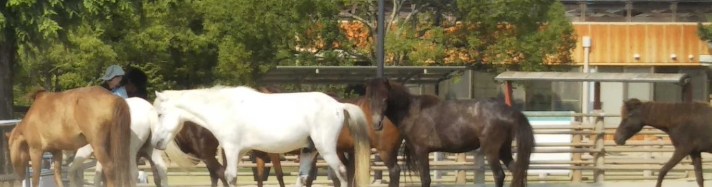
The Noma horse (‘Noma Uma’ in Japanese) is one of eight kinds of Japanese native horses which have been bred for a long time in an area around current Imabari city, Ehime prefecture[1]. They were originally tiny horses that were not fit for use in war, and they supported people’s lives as livestock animals that were used for farming and transporting farm products after they were sold to farmers. But when they were replaced by agricultural machines and bicycles, they lost their role as livestocks and were no longer needed by the people in Imabari. As a result, the number of Noma horses reduced to only six at that time[2].
After that, in order to save the Noma hoses from extinction, The society for preservation of Noma Uma was established in 1978, and some preservative activities for Noma horses were started[3]. Preservation and breeding have been promoted in The Nomauma Highland Park in Imabari City, and as of 2015, the number of Noma horses has been increasing to 51 in japan (40 horses in Imabari City, 1 in the Tokyo Ueno Zoo, 2 in the Toyama Municipal Family Park, 1 in the Osaka City Tennoji Zoo, 4 in the Ehime Prefectural Tobe Zoo, 2 in the Kochi Prefectural Noichi Animal Park, 1 in the Hiroshima City Asa Zoological Park)[4]. Unfortunately, although it is known that about 50 horses are needed to maintain the number of horses for 100 years as an original breed, currently we have not achieved that goal[4, 5].
The Noma horse research society has been founded to collect and offer academic informations related to the Noma horses world-widely, which were studied in not only veterinary medicine and biology but also history and sociology fields. We hope that the informations served by us make discussions on breeding and preservation of the Noma horse active, and relationship between people and Noma horses will be better.
野間馬(のまうま)は、現在の愛媛県今治市を中心とした地域で古くから飼育されてきた日本在来馬8種の中の一種です[1]。もともと合戦での使役に適さない体高の低い馬であり、農家に払い下げられてからは農耕や農作物の運搬に使役される家畜として人々の生活を支えていました。しかし、それらが農業用機械や自動車に取って代わられる時代を迎えると、家畜としての役割を失い、今治の人々から必要とされなくなってしまいました。その結果、一時はたった6頭まで数を減らすことになります[2]。
その後、野間馬を絶滅の危機から救おうと野間馬保存会が1978年に発足し、保護活動が始まりました[3]。今治市内に設置された野間馬ハイランドでの保護と繁殖がすすめられ、2015年の時点では、全国で51頭(今治市40頭、東京都恩賜上野動物園1頭、富山市ファミリーパーク2頭、大阪市天王寺動物園1頭、愛媛県立とべ動物園4頭、高知県立のいち動物公園2頭、広島市安佐動物公園1頭)にまでその数を回復させています[1]。しかし、一般に動物が種(品種)を維持していくには、50-100頭程度が必要であると言われており、それには遠く及ばないのが現状です(あくまでも種を100年存続させる条件)[4, 5]。
今後、いままで以上の保護や繁殖を目的とした活動が必要となるはずですが、日本の在来馬の中でも野間馬の知名度は低く、今治市民が寄せる関心も残念ながら高いとは言えません。使役動物・家畜としての役割を失い、かといって伴侶動物でもない野間馬を在来馬として保存する意義を今治市に限らず日本中の、ひいては世界中の人々に考えてもらうためにはより多くの情報が必要だと私たちは考えました。
野間馬研究会は、獣医学的・生物学的分野に限らず、歴史的・社会的分野も含め、各地に残る野間馬に関する情報の収集と整理を行い、それらを学術的に適切な形で発信していくことを目的に立ち上げられました。ここから発信される情報を元に、野間馬の繁殖と保存に関する議論が活発なものとなり、人と野間馬の関係がより良いものになることを期待してやみません。
- Japan Equine Affairs Association. https://www.bajikyo.or.jp/native_horse_01.php (described in Japanese) (accessed January, 15, 2019).
- Kubo, Y. 2017. The Report of Japanese Native Horse (Noma-uma). 2017. Survey Report for Animal Genetic Resources. 17, 1-7.
- Hattori, T., Takahashi, H., Takai, S., Matsuura, A., and Kikuchi, S. 2009. Conservation and Application of Native Horses as Regional Resources (article in Japanese). Proceedings of Annual Meeting of The Japanese Society of Irrigation, Drainage and Rural Engineering. 166-167.
- Soulé, ME., 1980. Thresholds for survival: maintaining fitness and evolutionary potential. In: Soulé, M.E., Wilcox, B.A. (Eds.), Conservation Biology: An Evolutionary-Ecological Perspective. Sinauer, Sunderland, MA. 151–169.
- Soulé, ME., 1985. What is conservation biology? Bioscience. 35, 727–734.
 Noma Horse Research